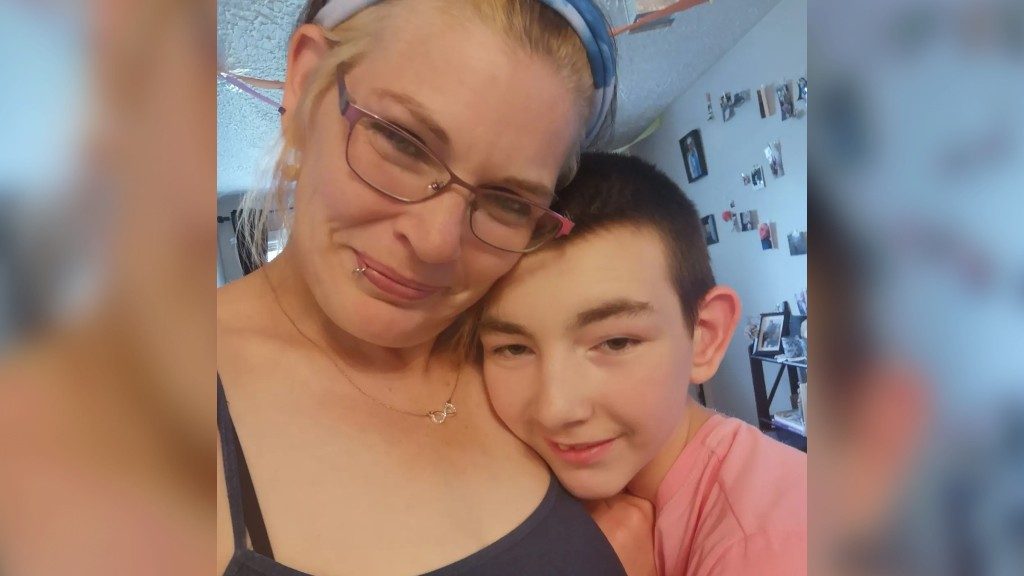
Photo: Saint John resident Heather Whittaker is pictured with her son Justice, who suffers from a rare form of epilepsy. Photo courtesy Heather Whittaker
Heather Whittaker woke up early one morning last September to find that her basement apartment in Saint John, N.B. had flooded due to a broken pipe.
It was the latest in a series of setbacks for Whittaker, who struggles to make ends meet on social assistance while serving as the sole caregiver for her teenage son Justice, who suffers from a rare form of epilepsy.
Their apartment, already lacking wheelchair access — which Justice increasingly required as his medical conditions worsened over the years — soon grew moldy, which affected his breathing and threatened to trigger seizures.
In a report published in November, the NB Media Co-op outlined the obstacles faced by the Whittaker family, including their search for a new home in New Brunswick, which is marked by a severe rental shortage of housing for people on low incomes.
Now, things seem to be looking up for Heather and Justice: they moved into a new NB Housing apartment unit in Moncton at the end of December. Heather expects to meet with new social workers and receive a delivery of medical supplies for Justice in the coming days and weeks.
“Here's hoping things are finally moving forward in the right direction,” Whittaker said in an email.
It’s often difficult for reporters to know the real impact of their work, particularly because governments observe strict privacy rules limiting what they can say about individual cases.
Whittaker said she was offered the apartment in mid-November. Around this time, the NB Media Co-op was making queries to the provincial government about her situation, but the wheels of government might have already been in motion. “I feel it was pure luck,” Whittaker said.
Shelley Petit, chair of the NB Coalition of Persons with Disabilities, said she thinks the report helped put pressure on the provincial government to help the Whittaker family.
“Normally one cannot just be moved from one sector or region of the province to another… It can take months, even years to get all your services re-installed. Miraculously, right after your piece on Heather and Justice aired, all of a sudden all kinds of exceptions were occurring.”
Examples of those exceptions included an increased rent subsidy from the province, according to Petit. The transfer of Heather’s file to the local office in Moncton also happened swiftly. “Nothing needed to be done by Heather. Many services were in place before they even arrived.”
In any case, Heather is cautiously optimistic that things are looking up for her family. “Only time will tell,” she said, adding that she believes reporting by the NB Media Co-op helps to raise awareness about the suffering of people who lack safe and adequate housing in New Brunswick.
David Gordon Koch is a journalist with the NB Media Co-op. This reporting has been made possible in part by the Government of Canada, administered by the Canadian Association of Community Television Stations and Users (CACTUS).
Ajouter un commentaire
A propos l’IJL
LJI Impact is the section of commediaportal.ca where the journalists and their organizations participating in CACTUS' Local Journalism Initiative can share their greatest successes.
Through the written stories, photos and videos you see in the LJI Impact section, you'll be able to read first hand accounts about how the presence of a community journalist is making a difference in communities across Canada through the Local Journalism Initiative and the Community Media Portal.
The Community Media Portal is a gateway to the audio-visual media created by community media centres across Canada. These include traditional community TV and radio stations, as well as online and new media production centres.
Community media are not-for-profit production hubs owned and operated by the communities they serve, established both to provide local content and reflection for their communities, as well as media training and access for ordinary citizens to the latest tools of media production, whether traditional TV and radio, social and online media, virtual reality, augmented reality or video games.
The Community Media Portal has been funded by the Local Journalism Initiative (the LJI) of the Department of Canadian Heritage, and administered by the Canadian Association of Community Television Users and Stations (CACTUS) in association with the Fédération des télévisions communautaires autonomes du Québec (the Fédération). Under the LJI, over 100 journalists have been placed in underserved communities and asked to produce civic content that underpins Canadian democratic life.


